Capabilities

Five areas where AI pays in a small or mid-sized business.

Four of them come from questions we ask about every business we assess. The fifth comes from a change in how customers find you at all. Which one you need is a diagnosis, and this page is written to help you make it before you call.

The area is not the product. What you buy is on /services/. What gets built is here.

Illustrative symptom check for a fictional business: four noticed symptoms ticked, each tagged with the capability area it belongs to, and a tally showing Sales and Revenue Operations as the area most symptoms point to.
Illustrative screens on this page use a fictional business and fictional data.
Self-diagnosis

Which of these describes our problem?

Start from the symptom rather than the category. Most owners already know what is wrong, they just have not heard it called anything.

  • Skilled people spend their afternoons retyping information that already exists somewhere else

    Business Process Automation

  • The same twenty questions arrive every week and a person answers each one from scratch

    Customer-Facing AI

  • Inquiries go cold because nobody got to them fast enough

    Customer-Facing AI

  • Revenue looks fine and margin does not, and nobody can say exactly where it went

    Sales & Revenue Operations

  • Quoting takes days, and the work you win is the work you quoted fastest rather than the work you wanted

    Sales & Revenue Operations

  • Growth means hiring, and hiring is the only lever anyone can name

    Scale & Leverage

  • Everything important runs through one person's head and calendar

    Scale & Leverage

  • Organic traffic is down, rankings have not moved, and nobody can explain the gap

    AI Search Visibility (AEO)

  • A customer told you they asked ChatGPT and it recommended somebody else

    AI Search Visibility (AEO)

More than one will usually fit. That is normal and it is what the assessment is for: it scores every candidate across all five areas and tells you which to do first.

What gets built

What are the five capability areas?

Each area is a class of system rather than a fixed product. What gets built inside it is decided by the assessment, from your workflows and your volumes.

What could we do faster?

Business Process Automation

You would notice this if: The bottleneck in your business is not skill or demand, it is the number of hours your best people spend on work that produces no judgment.

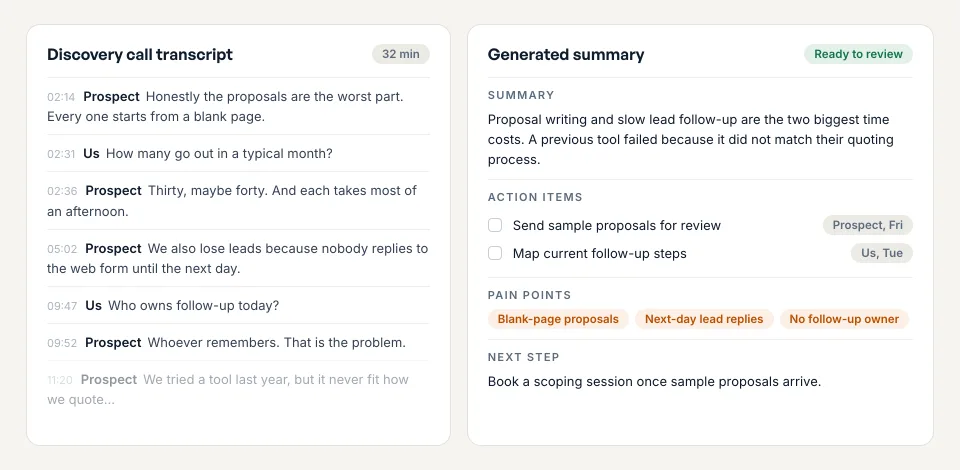
What a build looks like: A system that takes an input your team already produces, a call recording, an intake form, a pile of meeting notes, and returns the finished artifact somebody would otherwise have typed.

The measure: Hours reclaimed per week.
Full detail

Illustrative discovery call summarizer: a call transcript on the left and, on the right, the generated summary with action items, pain points, and a next step.
What could we offer now that used to be too expensive, technical, or complicated?

Customer-Facing AI

You would notice this if: Your customers are waiting on you for answers you have given a hundred times, or you are asking them to make a complicated choice with nothing to guide it.

What a build looks like: Something a customer uses directly and never thinks of as AI. A quote builder, a recommendation quiz, an intake assistant, a chatbot that answers from your actual policies rather than a generic model's guess about your industry.

The measure: Response time, qualified inquiries captured, questions resolved without a person.

Full detail

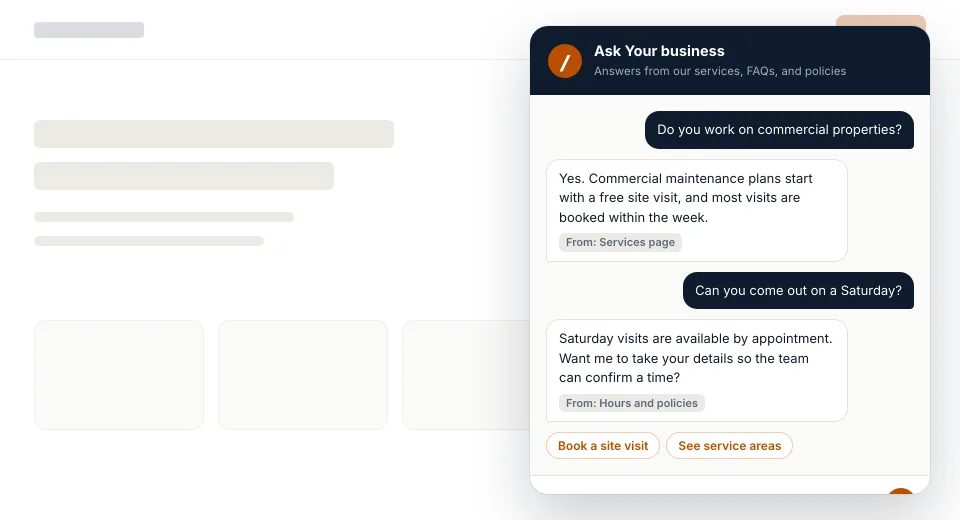
Illustrative website chat assistant for a fictional business, answering customer questions from its services page and policies and offering to book a site visit.
What would make this work more profitable?

Sales & Revenue Operations

You would notice this if: The problem is not winning work, it is what the work costs you between the quote and the invoice.

What a build looks like: A system sitting on the commercial path: scoring the lead, drafting the scope, flagging the change request as billable, or assembling the monthly report that currently eats a day.

The measure: Time to proposal, proposal-to-close rate, hours lost to non-billable admin.

Full detail

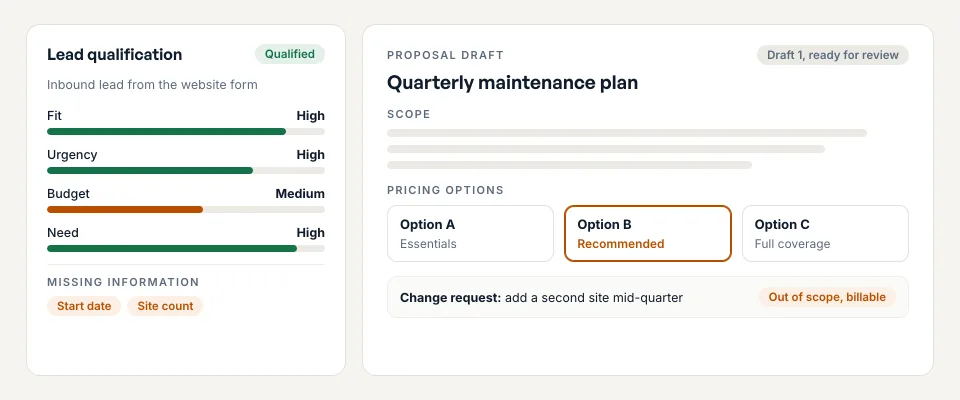
Illustrative lead qualification and proposal draft: an inbound lead scored on fit, urgency, budget, and need, beside a draft proposal with three pricing options and a change request flagged as out of scope and billable.
What could we repeat, automate, or sell?

Scale & Leverage

You would notice this if: Serving twice as many customers would mean hiring twice as many people, and nobody in the business believes that is actually the plan.

What a build looks like: A repeatable version of something currently bespoke. A custom service turned into a defined intake with defined outputs, an explanation you give weekly turned into something people can use without you, or a tool built once and sold to businesses like yours.

The measure: Clients served per staff member, and revenue not tied to owner hours.

Full detail

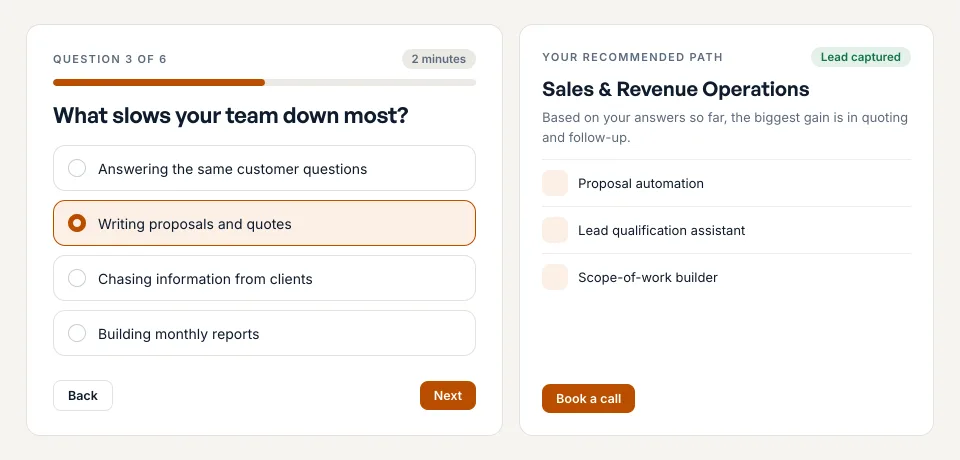
Illustrative self-guided quiz: a prospect answering question three of six, with a recommended service path and suggested builds shown alongside.
Are we visible when AI answers the customer's question?

AI Search Visibility (AEO)

You would notice this if: Your search rankings are steady and your traffic is not, or you have never seen what an AI system says about your business when a customer asks it.

What a build looks like: Not a build in the same sense. This is a measured practice with its own five-pillar scoring rubric, its own six-dimension gap analysis, its own remediation tiers, and a quarterly recheck that proves what moved.

The measure: Mention rate, share of voice against named competitors, sentiment, and citation count on the surfaces your customers actually use.

See how AI search visibility works

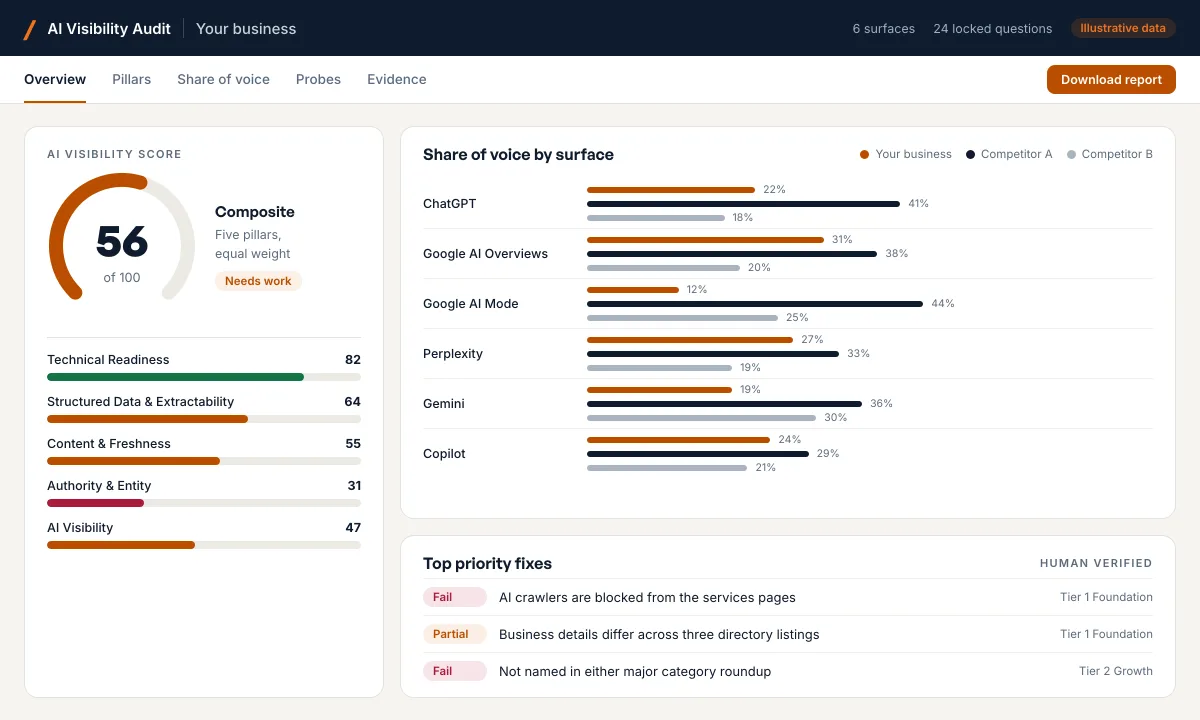
Illustrative AI Visibility Audit overview for a fictional business: a composite score of 56 out of 100, scores for the five pillars, share of voice against two competitors across six AI surfaces, and the top priority fixes.

Where do these four questions come from?

From a working framework we use to find opportunity in any business, built around four things a business can improve: speed, capability, margin, and scale. The four questions are just those four written the way an owner would say them.

Speed

What could we do faster?

Business Process Automation

Capability

What could we offer that used to be out of reach?

Customer-Facing AI

Margin

What would make this work more profitable?

Sales & Revenue Operations

Scale

What could we repeat without hiring?

Scale & Leverage

The fifth area does not fit that frame, and it is worth saying so rather than forcing it. AI search visibility is not an improvement to something you already do. It is a response to the search page ceasing to be a list of links, which is a change in the market rather than an inefficiency in your business. It sits alongside the other four because it is work we deliver, not because it answers the same question.

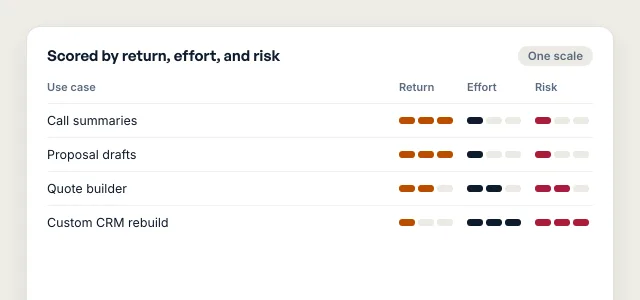
The framework is a tool for finding candidates, not a menu to buy from. In an assessment it is used to generate the list of candidate use cases, and then every use case on that list has to survive being scored on return, effort, and risk before it reaches your roadmap. Plenty do not.

See the full approach

How do capability areas relate to the four ways to buy?

They are two different questions and the site keeps them apart on purpose. The ladder on /services/ is how much you are committing to. The areas on this page are what the work is about. You choose a rung. The area is diagnosed.

In practice that means you do not buy Business Process Automation. You buy an AI Readiness Assessment, and it comes back saying that the highest-return opportunity in your business is a proposal system, which happens to sit in Sales & Revenue Operations, and that the automation you were expecting to be told about is worth less than you thought. That sequence is the entire point of assessing before building.

Illustrative scoring table rating four AI use cases on the same scale for return, effort, and risk.

The one exception is AI Search Visibility. It has its own front door, its own audit, and its own pricing structure, and it is bought directly by businesses that already know their search traffic is the problem. It is the only area on this page you can walk in and buy without an assessment first, because the audit is the assessment.

Compare the four ways to buy

Can we pick one and have you build it?

Not on its own, and it is worth explaining rather than dressing up. We build to carry out a plan we wrote. We cannot stand behind a result we did not scope, and a build we did not diagnose is somebody else's guess with our name on it.

There are two honest routes from here. If you want to know which area is actually costing you the most, that is an AI Readiness Assessment and it takes two to four weeks. If you already know exactly what you want built and want somebody to build it, that is a good position to be in. It is a build conversation rather than a strategy one, and we will route you to CAL Design, our development and production partner.

The exception, again, is AI Search Visibility. An AI Visibility Audit is a direct purchase and does not require anything before it.

Get started

Not sure which one you are looking at?

Most people are not, and several of these overlap by design. Tell us what the friction actually feels like day to day and we will tell you which area it belongs to, whether it is worth systematizing at all, and what it would take to find out properly.

We reply within one business day.